Two-sided ETH vault
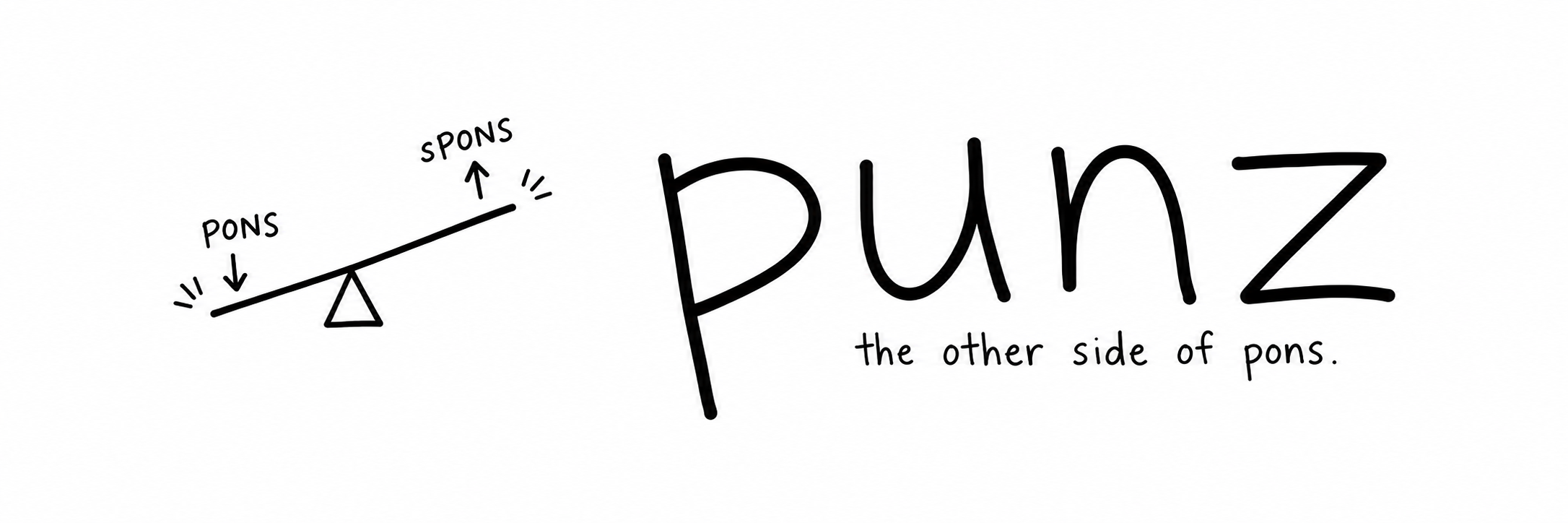
sPONS represents shares of the short side; lPONS represents the long side. Rebalances transfer existing ETH between them.
sPONS NAV = short-side ETH ÷ sPONS supply
 Launch status
Trade it with ETH. Pool fees build an onchain short on PONS. Collected PUNZ gets burned. The meme is on top. The mechanism is underneath.
Meet the mechanismPUNZ is designed to trade in a normal ETH pool. The difference is what happens to the fees.
Buy or sell PUNZ through its ETH pool. The pool charges a 3% trading fee. You don’t need to open a separate short position or hold a second token.
Two kinds of value. PUNZ has a market price and a separate redemption backing value. They are not the same, and neither is guaranteed to rise.
The vault has two pools of ETH: long and short. A rebalance moves ETH from the losing side to the winning side. Try a price move.
One illustrative rebalance at 1× leverage. No deposits, redemptions, or fees. This models the short vault, not PUNZ’s market price.
0.2000 ETH moves from long to short.
The balance matters. A larger long side can amplify a short’s gain when PONS falls. A smaller long side limits it. Returns also depend on the path prices take.
A tokenized short, a fee-harvesting backing contract, and a normal ETH market. No exchange account sits behind the short.
sPONS represents shares of the short side; lPONS represents the long side. Rebalances transfer existing ETH between them.
A Uniswap v3 time-weighted average price references PONS against ETH. It smooths short-term moves, with an oracle window before vault mint and redemption claims settle.
How a TWAP works ↗Backing v2 acquires sPONS through its market when the price is close enough to NAV. Otherwise, ETH follows the vault’s delayed mint-and-claim path.
Keepers call rebalance, harvest, and claim. These functions are permissionless: another caller can continue the work. Execution still depends on transactions being submitted.
At 1× leverage, let r = new PONS price ÷ previous PONS price, with both prices measured in ETH.
If PONS falls (r < 1)long → short = long ETH × (1 − r)
If PONS rises (r > 1)short → long = short ETH × (1 − 1/r)
Transfers come from the losing side’s available balance. The simulation assumes both sides have shares. This is not a fixed inverse-price tracker: pool imbalance and sequential rebalances change the result.
You don’t have to burn anything yourself to hold PUNZ. The automatic burn and optional redemption are two different things.
Your sPONS = backing held × your PUNZ ÷ outstanding PUNZ
The mechanism has been exercised on prototype deployments. Final PUNZ contracts and market links have not been announced here.
Announced at launch.
Final contract verification, vault ownership, liquidity lock details, and token allocation will be published with the launch addresses.
No. A PONS decline can increase the short-side NAV, depending on pool balances. PUNZ’s market price is set by its own trading. Backing value can also fall if the short loses value.
No. The vault transfers ETH between long and short shareholders using the PONS/ETH reference price. Buying short exposure does not itself sell PONS or force its price down.
No. It is an onchain perpetual pool with transferable ERC-20 shares. The exposure lives in the ETH vault, rather than an exchange account.
The designated trading pool charges a 3% fee. When fees are harvested, ETH-denominated fees acquire sPONS backing, while PUNZ-denominated fees are burned. That is different from saying every fee is immediately converted into ETH or shorts.
The long side supplies the short side’s gains, so backing is finite. Oracle lag, manipulation, liquidity, delayed transactions, and smart-contract faults can affect value and exits. The build record describes prototype testing, not an independent audit. A tokenized short can lose most of its value without a conventional liquidation event.